

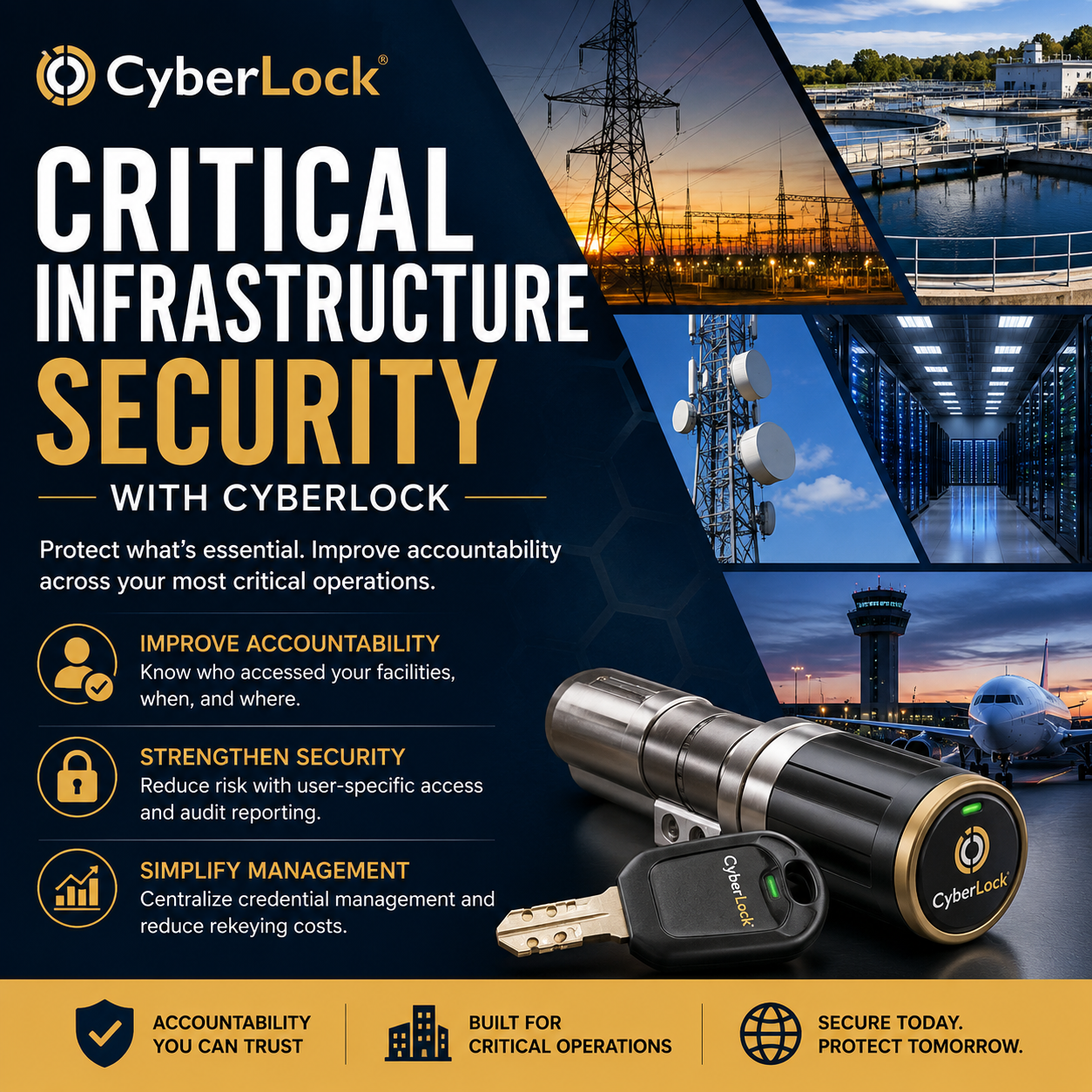
What Is Critical Infrastructure Security and How Does CyberLock Improve It?
Critical infrastructure security is the practice of protecting facilities, systems, and operational assets that support essential services such as electric power, water and wastewater treatment, telecommunications, transportation networks, manufacturing operations, government services, and data center infrastructure. Effective security requires more than preventing unauthorized entry. Organizations must also maintain accountability for employees, contractors, vendors, maintenance personnel, and service providers who access critical facilities.
As infrastructure networks expand across multiple locations and remote facilities, traditional lock-and-key systems often create visibility and accountability challenges. Organizations may know who possesses a key but have little insight into who accessed a facility, when access occurred, or whether access was authorized.
The CyberLock Access Control System helps critical infrastructure operators improve accountability through programmable electronic smart keys, intelligent lock cylinders, user-specific permissions, centralized credential management, and detailed audit reporting. Unlike traditional keys, CyberLock associates access activity with individual users, creating greater visibility into facility operations while reducing many of the risks associated with uncontrolled credentials.
CyberLock is commonly deployed throughout:
- Electrical substations
- Water treatment facilities
- Wastewater operations
- Telecommunications infrastructure
- Transportation networks
- Airports and aviation facilities
- Manufacturing operations
- Data centers
- Municipal facilities
- Remote infrastructure assets
A key advantage of CyberLock is its ability to provide electronic accountability without requiring extensive hardwired power, networking, or communications infrastructure at every access point. This makes the system particularly valuable for organizations managing geographically dispersed operations and remote facilities.
When combined with CyberAudit-Web Reporting, organizations gain centralized visibility into credential assignments, facility activity, contractor access, audit trails, and operational oversight across multiple locations.
For many critical infrastructure operators, CyberLock provides a practical alternative to traditional mechanical keys and costly hardwired access control systems by helping improve accountability, strengthen infrastructure protection, simplify credential management, and support operational continuity throughout complex infrastructure environments.
Security Challenges Facing Critical Infrastructure Operators
Critical infrastructure operators face security and accountability challenges that extend far beyond protecting a single facility. Many organizations are responsible for maintaining essential services across large geographic regions while supporting employees, contractors, vendors, maintenance personnel, engineers, inspectors, and service providers who require access to multiple locations.
Whether managing utility networks, transportation systems, telecommunications infrastructure, manufacturing operations, data centers, municipal facilities, or government operations, organizations must balance operational efficiency with infrastructure protection and accountability.
As infrastructure networks continue to expand, maintaining visibility into facility activity becomes increasingly difficult.
Distributed Infrastructure Creates Accountability Challenges
Many critical infrastructure operators oversee a combination of staffed facilities and remote operational assets.
Common examples include:
- Electrical substations
- Water treatment facilities
- Pump stations
- Telecommunications sites
- Communications shelters
- Data centers
- Operations centers
- Maintenance facilities
- Fleet operations
- Equipment storage locations
- Administrative offices
- Remote infrastructure assets
These facilities often operate across multiple cities, counties, states, or service territories. Some locations may be visited daily, while others are accessed only periodically by maintenance crews, contractors, engineers, or service providers.
Traditional key systems often provide little visibility into who entered a facility, when access occurred, or whether access was appropriate. As the number of facilities grows, accountability becomes increasingly difficult to maintain.
Organizations operating utility and infrastructure networks frequently encounter challenges similar to those discussed in CyberLock Power and Utility Security, CyberLock Water Treatment Facility Security, and CyberLock Telecom Infrastructure Security.
Contractor and Vendor Access Continues to Expand
Most critical infrastructure organizations rely on outside firms to support daily operations and long-term infrastructure projects.
These may include:
- Engineering firms
- Construction companies
- Utility contractors
- Telecommunications providers
- Equipment manufacturers
- Maintenance vendors
- Service contractors
- Technology providers
- Infrastructure consultants
Managing access across these groups presents ongoing challenges.
Organizations must provide authorized access while maintaining confidence that credentials are being used appropriately and that access is removed when projects conclude. Without effective oversight, temporary access can evolve into long-term security exposure.
Remote Facilities Are Difficult to Monitor
Many of the most important infrastructure assets operate in locations where onsite security personnel are not present.
Examples include:
- Utility substations
- Pump stations
- Communications towers
- Rail infrastructure
- Equipment compounds
- Fleet support facilities
- Remote operations sites
- Backup infrastructure facilities
These locations often become accountability blind spots.
Organizations may know who was issued a key, but have little visibility into who actually accessed a facility, when activity occurred, or whether access aligned with operational requirements.
As remote infrastructure continues to expand, improving accountability becomes increasingly important.
Infrastructure Protection Requirements Continue to Evolve
Critical infrastructure operators face growing pressure to strengthen operational oversight and protect facilities that support essential services.
Potential risks may include:
- Unauthorized access
- Equipment theft
- Material theft
- Vandalism
- Operational disruptions
- Credential misuse
- Contractor accountability gaps
- Loss of facility visibility
The consequences of these issues can extend beyond individual facilities and affect broader operational performance.
As a result, many organizations seek solutions that provide:
- Stronger accountability
- Better credential management
- Detailed audit reporting
- Improved contractor oversight
- Reduced rekeying costs
- Protection for remote facilities
- Centralized administration
- Visibility across distributed infrastructure
Accountability Has Become a Core Security Requirement
For many critical infrastructure operators, security is no longer defined solely by locks, fences, gates, and physical barriers.
Organizations increasingly need the ability to verify who accessed a facility, when access occurred, and whether access was appropriate.
This shift has elevated accountability from a security enhancement to a core operational requirement.
As organizations seek greater visibility across their infrastructure networks, many discover that traditional key systems were never designed to support the level of accountability required in today’s critical infrastructure environments.
Why Traditional Keys Fall Short for Critical Infrastructure Security
Traditional lock-and-key systems have been used throughout critical infrastructure environments for decades because they are familiar, relatively inexpensive, and easy to deploy. However, the accountability, visibility, and operational oversight requirements facing today’s infrastructure operators have evolved far beyond what traditional mechanical keys were designed to support.
Organizations responsible for protecting essential infrastructure increasingly require detailed insight into who accessed a facility, when access occurred, which locations were accessed, and whether access aligned with operational responsibilities. Traditional keys provide none of this information.
As a result, many critical infrastructure operators find themselves managing growing security and accountability challenges with tools that were never designed for modern infrastructure environments.
Traditional Keys Provide No Visibility Into Facility Activity
One of the biggest limitations of mechanical key systems is the complete lack of auditability.
When a traditional key is used to access:
- An electrical substation
- A water treatment facility
- A communications shelter
- A transportation operations center
- A maintenance facility
- A data center
- A government building
- A remote infrastructure site
there is no record of:
- Who entered the facility
- When access occurred
- How long access was required
- Whether access was authorized
- Whether unusual activity occurred
If equipment is damaged, materials disappear, unauthorized access is suspected, or operational issues arise, administrators often have little information available to support an investigation.
For organizations responsible for essential services, this lack of visibility creates significant accountability gaps.
Lost Keys Create Expensive and Ongoing Security Risks
Critical infrastructure operators often manage hundreds or thousands of keys across multiple facilities and departments.
When a key is lost, stolen, misplaced, or not returned following employee turnover, organizations may be forced to:
- Replace locks
- Rekey facilities
- Redistribute credentials
- Update key inventories
- Coordinate access changes across multiple locations
For geographically dispersed organizations, these projects can become both expensive and operationally disruptive.
In many cases, administrators may never know whether a lost key presents an actual security risk, creating additional uncertainty throughout the organization.
Shared Keys Eliminate Accountability
Many organizations continue to rely on shared keys among employees, maintenance personnel, contractors, supervisors, and service providers.
While this may appear convenient, shared credentials make meaningful accountability nearly impossible.
When multiple individuals use the same key:
- Access cannot be tied to a specific user
- Investigations become more difficult
- Contractor oversight is weakened
- Credential management becomes less effective
Over time, organizations may lose confidence in their ability to determine who accessed a facility and why.
This challenge is particularly common in environments such as Power & Utility Security, Transportation Infrastructure Security, Telecom Infrastructure Security, and Water Treatment Facility Security, where large numbers of personnel may require access across multiple locations.
Contractor Access Becomes Increasingly Difficult to Manage
Critical infrastructure organizations routinely issue keys to:
- Contractors
- Engineers
- Inspectors
- Vendors
- Service providers
- Maintenance personnel
Traditional key systems provide few practical tools for controlling or monitoring these credentials.
Administrators often struggle to answer important questions such as:
- Does this individual still need access?
- Which facilities can they enter?
- Was the key returned?
- Has the project been completed?
- Who approved continued access?
As contractor activity expands, maintaining effective oversight becomes increasingly difficult.
Infrastructure Networks Continue to Grow
Many infrastructure operators are managing more facilities today than they were a decade ago.
Organizations continue to expand:
- Utility networks
- Communications infrastructure
- Transportation systems
- Municipal operations
- Manufacturing facilities
- Technology environments
As these networks grow, the limitations of traditional keys become more apparent.
What may have worked for a handful of facilities often becomes difficult to manage across dozens, hundreds, or thousands of access points.
Modern Infrastructure Requires Modern Accountability
Today’s infrastructure operators require more than physical access control.
They need:
- User-specific credentials
- Facility-specific permissions
- Access scheduling
- Credential expiration
- Audit reporting
- Contractor accountability
- Centralized administration
- Visibility across multiple locations
Traditional mechanical keys were never designed to provide these capabilities.
For organizations seeking stronger accountability, improved operational oversight, and greater control over critical facilities, traditional key systems often become one of the largest barriers to building a modern infrastructure security program.
This is why many operators begin looking beyond traditional keys and exploring solutions that provide electronic accountability without sacrificing operational flexibility.
Why Hardwired Access Control Systems Are Not Always Practical for Critical Infrastructure
Recognizing the limitations of traditional mechanical keys, many critical infrastructure operators explore electronic access control systems such as card readers, keypads, biometric technologies, mobile credentials, and network-connected security platforms. These systems can provide valuable accountability and access management capabilities within centralized facilities.
However, critical infrastructure environments present a unique challenge.
Unlike traditional office buildings, campuses, or commercial facilities, many infrastructure operators manage geographically dispersed assets spread across large service territories. Extending hardwired access control systems to every facility, gate, enclosure, and remote asset can become expensive, complex, and difficult to justify.
For many organizations, the challenge is not determining whether electronic accountability is valuable. The challenge is determining how to achieve that accountability across hundreds of distributed locations.
Critical Infrastructure Often Extends Far Beyond Central Facilities
Many organizations operate facilities such as:
- Electrical substations
- Switching stations
- Relay houses
- Water treatment facilities
- Pump stations
- Communications shelters
- Cell tower sites
- Rail infrastructure
- Fleet operations facilities
- Equipment compounds
- Maintenance yards
- Remote operational assets
While centralized facilities may support traditional electronic access control systems, many of these locations operate in environments where power, networking, and communications infrastructure are limited or unavailable.
Organizations managing environments similar to Power & Utility Security, Water Treatment Facility Security, Telecom Infrastructure Security, and Transportation Infrastructure Security frequently encounter these challenges.
Infrastructure Deployment Costs Can Escalate Quickly
Most hardwired access control systems require:
- Continuous electrical power
- Network connectivity
- Communication infrastructure
- Control panels
- Readers and field devices
- Ongoing software support
- Equipment maintenance
- Future upgrades
Deploying this infrastructure across dozens or hundreds of remote locations can significantly increase both initial project costs and long-term operating expenses.
In many cases, organizations must also account for:
- Trenching
- Conduit installation
- Network expansion
- Cellular communication costs
- Environmental protection requirements
- Ongoing maintenance visits
As facilities become more remote, implementation costs often increase substantially.
Reliability Is Essential in Critical Infrastructure Environments
Critical infrastructure organizations depend on systems that support operations during:
- Severe weather events
- Utility outages
- Emergency response situations
- Natural disasters
- Infrastructure failures
- Storm restoration activities
- After-hours service calls
Authorized personnel must be able to access facilities when operational demands require immediate action.
Security systems that rely heavily on communications networks, external infrastructure, or centralized connectivity may introduce additional operational considerations that infrastructure operators must carefully evaluate.
Infrastructure Networks Continuously Evolve
Critical infrastructure environments rarely remain static.
Organizations routinely:
- Expand service territories
- Upgrade facilities
- Add new infrastructure
- Modernize operations
- Deploy new technologies
- Construct new facilities
- Reconfigure operational assets
As infrastructure evolves, access control requirements evolve as well.
Hardwired systems can become expensive and time-consuming to modify when facilities, operational requirements, or access needs change.
Many organizations seek a solution that can scale alongside their infrastructure without requiring extensive redesign or additional infrastructure investments.
The Accountability Gap Between Keys and Hardwired Systems
Many infrastructure operators find themselves caught between two imperfect options:
Traditional Keys
- Simple to deploy
- Low infrastructure requirements
- Limited accountability
- No audit trail
Hardwired Access Control Systems
- Strong accountability
- Detailed reporting
- Higher infrastructure requirements
- Greater implementation complexity
This creates a significant gap between security needs and practical deployment realities.
CyberLock Bridges the Gap
The CyberLock Access Control System helps bridge the gap between traditional keys and hardwired access control systems.
By combining programmable electronic smart keys, intelligent lock cylinders, user-specific permissions, centralized credential management, and detailed audit reporting, CyberLock delivers electronic accountability without requiring extensive power, networking, or communications infrastructure at every access point.
This makes CyberLock particularly effective for:
- Remote utility infrastructure
- Telecommunications networks
- Transportation systems
- Water and wastewater facilities
- Industrial operations
- Municipal infrastructure
- Distributed critical infrastructure environments
Organizations gain many of the accountability benefits associated with electronic access control while maintaining the flexibility and practicality required to support geographically dispersed operations.
For many critical infrastructure operators, CyberLock represents a practical path toward modern accountability without the complexity often associated with large-scale hardwired access control deployments.
How CyberLock Improves Critical Infrastructure Security
Critical infrastructure operators require more than physical security. They need accountability, visibility, credential control, and the ability to manage access across multiple facilities, departments, contractors, and geographic regions.
The CyberLock Access Control System was designed to address these challenges by combining programmable electronic smart keys, intelligent lock cylinders, centralized credential management, user-specific permissions, and detailed audit reporting into a scalable access control solution.
Unlike traditional mechanical key systems, CyberLock transforms every credential into a managed asset that can be assigned, monitored, updated, and audited throughout its lifecycle.
For organizations responsible for protecting essential infrastructure, this creates a significantly higher level of accountability without sacrificing operational flexibility.
User-Specific Access Permissions
Critical infrastructure environments often involve a wide variety of personnel, including:
- Employees
- Supervisors
- Maintenance teams
- Engineers
- Contractors
- Vendors
- Inspectors
- Service providers
- Emergency response personnel
Not every individual should have access to every facility.
CyberLock allows administrators to assign permissions based on specific operational requirements.
Credentials can be configured to:
- Access designated facilities
- Operate during approved schedules
- Support temporary projects
- Expire automatically when work is completed
- Restrict access to sensitive infrastructure assets
This helps organizations improve accountability while reducing unnecessary security exposure.
Detailed Audit Trails and Accountability
One of CyberLock’s most valuable capabilities is visibility.
Each CyberKey can record access activity, helping organizations better understand how facilities are being used and who is accessing critical assets.
Administrators can review information such as:
- User activity
- Facility access history
- Access dates and times
- Credential usage
- Failed access attempts
- Contractor activity
- Access exceptions
This visibility helps organizations strengthen oversight, investigate incidents, verify contractor activity, and support operational governance initiatives.
For many infrastructure operators, accountability becomes one of the most valuable security improvements CyberLock provides.
Improved Contractor and Vendor Management
Contractor access remains one of the most common security challenges facing critical infrastructure organizations.
Construction firms, utility contractors, telecommunications providers, maintenance vendors, engineers, inspectors, and service providers often require access to multiple facilities throughout a project lifecycle.
CyberLock helps organizations maintain tighter control by allowing credentials to be:
- Assigned to specific individuals
- Restricted to designated facilities
- Scheduled for approved access windows
- Automatically expired when projects conclude
This helps reduce administrative burdens while improving oversight and accountability.
Organizations operating facilities similar to those discussed in Power & Utility Security, Telecom Infrastructure Security, Transportation Infrastructure Security, and Airport Security frequently benefit from these capabilities.
Securing Remote Infrastructure
One of CyberLock’s greatest advantages is its ability to extend electronic accountability to remote facilities.
Many infrastructure operators are responsible for securing:
- Electrical substations
- Pump stations
- Communications shelters
- Cell tower sites
- Equipment compounds
- Maintenance facilities
- Fleet operations centers
- Remote operational assets
These locations often operate without onsite personnel and may not have the infrastructure required to support traditional hardwired access control systems.
CyberLock helps organizations establish accountability throughout these environments without requiring extensive power, networking, or communications infrastructure at every access point.
Centralized Credential Management
As infrastructure networks expand, managing credentials becomes increasingly complex.
CyberLock helps organizations maintain greater control through centralized administration of:
- User permissions
- Facility assignments
- Credential schedules
- Access rights
- Contractor credentials
- Audit records
This helps reduce administrative complexity while improving consistency across multiple facilities and departments.
When integrated with CyberAudit-Web Reporting, organizations gain even greater visibility into credential activity and facility access across distributed operations.
Reduced Rekeying Costs and Administrative Burdens
Lost keys have historically created expensive and time-consuming security challenges.
Traditional lock systems often require:
- Lock replacement
- Rekeying projects
- Credential redistribution
- Inventory updates
- Administrative coordination
CyberLock helps reduce many of these burdens by providing a more flexible approach to credential management.
Organizations can improve security while minimizing the operational disruptions often associated with traditional key systems.
Scalable Security for Growing Infrastructure Networks
Whether managing ten facilities or thousands of distributed assets, critical infrastructure operators require security solutions that can scale alongside their operations.
CyberLock supports:
- Utility networks
- Transportation systems
- Telecommunications infrastructure
- Manufacturing environments
- Data centers
- Municipal facilities
- Government operations
- Multi-site infrastructure organizations
As organizations expand, CyberLock helps maintain consistent accountability, credential management, and operational oversight throughout the infrastructure lifecycle.