Common Water and Wastewater Assets Secured with CyberLock
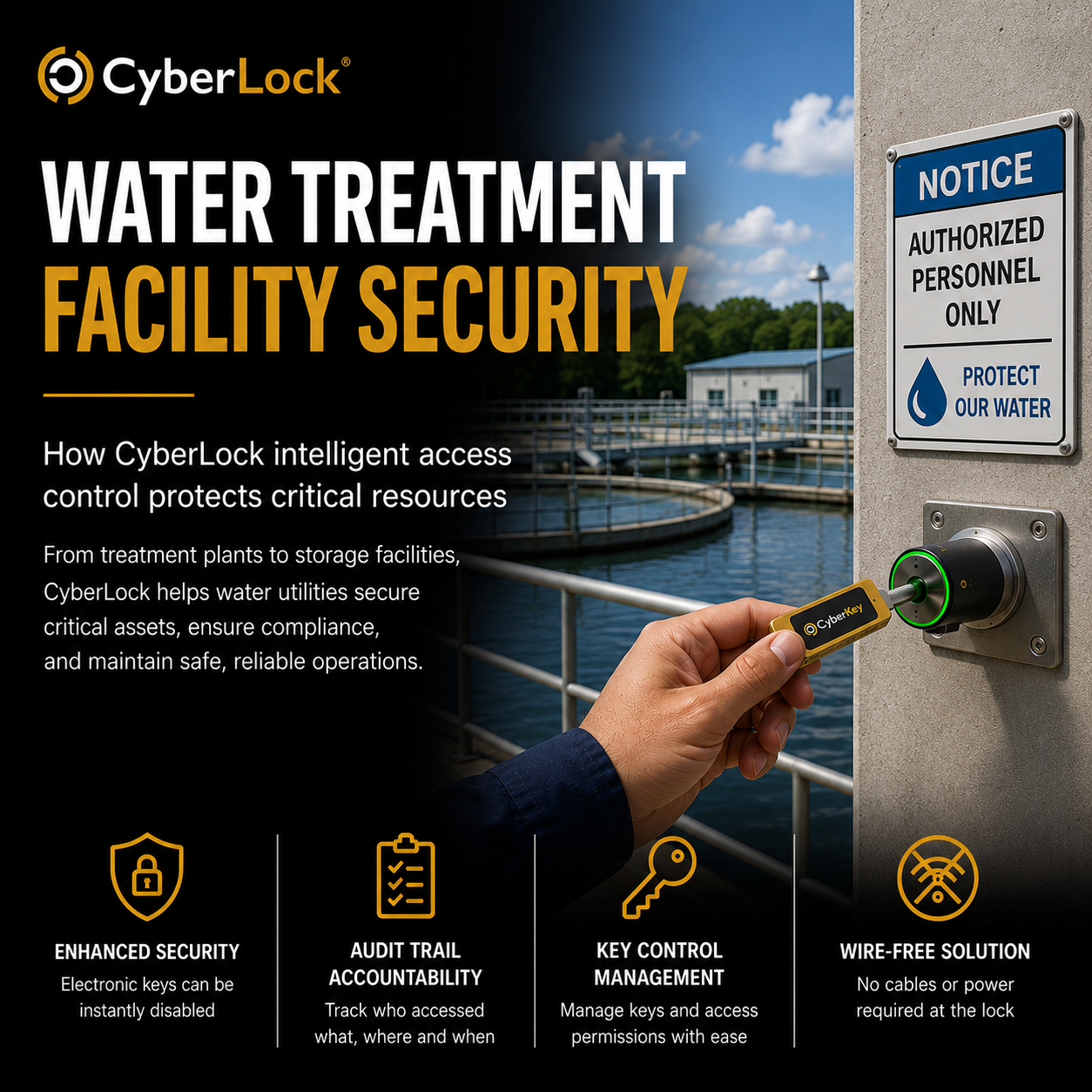
Water and wastewater organizations are responsible for protecting a wide variety of facilities that support drinking water treatment, wastewater processing, water distribution, pumping operations, storage systems, communications infrastructure, maintenance activities, and emergency response operations.
Many of these facilities operate without full-time onsite personnel and require access by employees, contractors, engineers, inspectors, maintenance teams, service providers, and emergency response personnel. Maintaining accountability throughout these environments is essential for infrastructure protection, operational oversight, regulatory readiness, and reliable utility service.
The CyberLock Access Control System helps water and wastewater operators improve accountability across critical infrastructure while supporting the operational flexibility required throughout modern utility systems.
Water Treatment Plants
Water treatment facilities are among the most critical assets within a water utility network.
These facilities often contain:
- Treatment systems
- Chemical storage areas
- Pumping equipment
- Monitoring systems
- Operations centers
- Communications infrastructure
- Maintenance facilities
- Critical utility equipment
CyberLock helps organizations improve accountability by providing visibility into who accessed a facility, when activity occurred, and which credential was used.
For many water utilities, improving accountability at treatment plants is one of the primary reasons for implementing CyberLock.
Wastewater Treatment Facilities
Wastewater treatment plants frequently require access by operations personnel, maintenance teams, contractors, engineers, inspectors, and service providers.
CyberLock helps improve oversight throughout:
- Treatment operations
- Mechanical equipment areas
- Electrical rooms
- Maintenance facilities
- Chemical storage areas
- Operations support environments
Organizations gain stronger credential management while maintaining operational flexibility.
Pump Stations
Pump stations are among the most common CyberLock applications within water utility operations.
These facilities often:
- Operate remotely
- Function without full-time onsite personnel
- Require periodic maintenance access
- Support critical system operations
CyberLock helps organizations improve accountability by providing greater visibility into activity occurring at these locations.
Administrators gain better insight into:
- Who entered the facility
- When access occurred
- Whether contractor activity was authorized
- Whether access aligned with operational responsibilities
Lift Stations
Lift stations present many of the same accountability challenges as pump stations.
Because these facilities are often geographically dispersed throughout a service area, maintaining oversight can be difficult using traditional key systems.
CyberLock helps improve accountability throughout:
- Lift stations
- Wastewater collection infrastructure
- Utility support facilities
- Remote operational environments
This visibility helps support operational reviews, contractor management, and infrastructure oversight.
Water Towers and Storage Facilities
Water towers and storage facilities play a critical role in maintaining system reliability and service continuity.
CyberLock is commonly used to secure:
- Elevated water towers
- Ground storage tanks
- Storage facilities
- Utility compounds
- Water distribution support infrastructure
These locations often benefit from improved credential management and audit reporting capabilities.
Communications Shelters and Technology Infrastructure
Modern water systems increasingly rely on communications infrastructure to support operations, monitoring, and system management.
CyberLock helps secure:
- Communications shelters
- Network facilities
- Technology support environments
- Monitoring equipment locations
- Utility communications infrastructure
Organizations responsible for broader communications systems may also benefit from Telecom Infrastructure Security.
SCADA Support Facilities
Many water and wastewater organizations operate facilities that support monitoring and operational technology environments.
CyberLock is frequently deployed throughout:
- SCADA support locations
- Communications rooms
- Equipment enclosures
- Monitoring facilities
- Technology support infrastructure
These environments often require stronger accountability due to the critical role they play in utility operations.
Maintenance Facilities and Utility Compounds
Maintenance teams support daily operations, infrastructure improvements, emergency repairs, and equipment servicing.
CyberLock is commonly used to secure:
- Maintenance facilities
- Utility compounds
- Equipment yards
- Tool storage areas
- Fleet support locations
- Operations support facilities
Improved accountability helps organizations better manage personnel access, contractors, and operational resources.
Emergency Operations and Response Facilities
Water and wastewater organizations must occasionally coordinate emergency response efforts related to infrastructure failures, severe weather events, utility incidents, and service interruptions.
CyberLock can help improve accountability throughout:
- Emergency operations centers
- Response coordination facilities
- Temporary support locations
- Contractor staging areas
- Infrastructure recovery operations
These environments often experience increased activity during emergency events and benefit from stronger credential oversight.
Remote Water Infrastructure
Many organizations operate infrastructure throughout large service territories.
CyberLock helps secure:
- Remote pump stations
- Lift stations
- Storage facilities
- Communications shelters
- Utility compounds
- Equipment yards
- Field operations sites
- Remote support facilities
Because CyberLock provides electronic accountability without requiring extensive hardwired infrastructure, it is particularly effective for these distributed environments.
Supporting the Entire Water Utility Ecosystem
Unlike solutions limited to a specific facility type, CyberLock can be deployed throughout an entire water and wastewater network.
Organizations frequently implement CyberLock across:
- Water treatment plants
- Wastewater treatment facilities
- Pump stations
- Lift stations
- Water towers
- Storage facilities
- Communications infrastructure
- Maintenance facilities
- Utility compounds
- Remote water assets
When integrated with CyberAudit-Web Reporting, administrators gain centralized visibility into credential activity, facility access, contractor usage, and accountability throughout the utility system.
A Unified Approach to Water Utility Accountability
Whether securing treatment facilities, managing contractor access, improving oversight of pump stations, supporting emergency operations, or protecting remote infrastructure, CyberLock provides a consistent framework for accountability throughout the water utility network.
The result is stronger credential management, improved operational visibility, better contractor oversight, enhanced infrastructure protection, and a more effective approach to securing critical water and wastewater assets.
structure.
This is where CyberAudit-Web Reporting becomes a powerful component of a water utility accountability strategy.
Working alongside the CyberLock Access Control System, CyberAudit-Web provides centralized credential management, audit reporting, access administration, contractor oversight, and operational visibility throughout the water and wastewater network.
For many utility operators, CyberAudit-Web transforms access control from a key management process into an operational accountability platform.
Centralized Credential Management Across the Water Utility Network
Water and wastewater organizations often manage access for:
- Operations personnel
- Plant supervisors
- Engineers
- Maintenance teams
- Contractors
- Utility service providers
- Equipment specialists
- Communications technicians
- Inspectors
- Emergency response personnel
As infrastructure expands across multiple facilities and service territories, maintaining visibility into credential assignments becomes increasingly difficult.
CyberAudit-Web helps administrators centrally manage:
- User permissions
- Credential assignments
- Facility-specific access rights
- Contractor credentials
- Access schedules
- Credential expiration dates
- Department-level permissions
This centralized approach helps improve accountability while reducing administrative burdens throughout the organization.
Visibility Across Treatment Facilities and Remote Infrastructure
One of the greatest challenges facing water and wastewater operators is maintaining visibility across geographically dispersed assets.
Many organizations oversee:
- Water treatment plants
- Wastewater treatment facilities
- Pump stations
- Lift stations
- Water towers
- Storage facilities
- Communications shelters
- Maintenance facilities
- Utility compounds
- Remote operational assets
Without centralized oversight, understanding facility activity across these environments can be difficult.
CyberAudit-Web helps administrators review credential activity and facility access throughout the utility network from a single management platform.
Detailed Audit Reporting
Visibility is one of the most important components of accountability.
CyberAudit-Web helps organizations review:
- Access events
- User activity
- Credential usage
- Facility access history
- Failed access attempts
- Contractor activity
- Access exceptions
- Administrative actions
This information supports:
- Operational reviews
- Contractor oversight
- Infrastructure protection initiatives
- Incident investigations
- Credential management programs
- Accountability efforts
For many organizations, audit visibility becomes one of the most valuable benefits of the CyberLock ecosystem.
Improving Contractor and Vendor Oversight
Water and wastewater organizations often rely on outside organizations to support:
- Construction projects
- Infrastructure upgrades
- Equipment installations
- Maintenance programs
- Communications systems
- Technology initiatives
- Emergency repairs
Managing contractor access across treatment facilities and remote infrastructure can become increasingly complex.
CyberAudit-Web helps administrators:
- Assign temporary credentials
- Establish expiration dates
- Restrict access to designated facilities
- Review contractor activity
- Verify access history
- Monitor credential usage
These capabilities help strengthen accountability while simplifying contractor administration.
Supporting Emergency Utility Operations
Water and wastewater operators must occasionally respond to:
- Equipment failures
- Utility emergencies
- Service interruptions
- Infrastructure incidents
- Severe weather events
- Emergency repair projects
During these situations, organizations may need to quickly coordinate access for employees, contractors, vendors, and temporary support personnel.
CyberAudit-Web helps maintain visibility throughout these operations by providing centralized oversight of credential assignments and facility activity.
This supports accountability while allowing organizations to respond quickly to operational challenges.
Strengthening Operational Governance
As water and wastewater organizations continue modernizing infrastructure and improving operational processes, accountability expectations often increase.
CyberAudit-Web helps support governance initiatives by maintaining centralized records of:
- Credential assignments
- User permissions
- Facility access history
- Contractor activity
- Administrative changes
- Audit records
This visibility helps organizations strengthen operational oversight while improving confidence in access control programs.
One Platform for Multiple Water Utility Environments
A significant advantage of CyberAudit-Web is its ability to support accountability across a wide range of facility types.
Organizations can manage activity throughout:
- Water treatment plants
- Wastewater treatment facilities
- Pump stations
- Lift stations
- Water towers
- Storage facilities
- Communications infrastructure
- Maintenance facilities
- Utility compounds
- Remote infrastructure
Rather than maintaining separate oversight processes for each environment, administrators gain centralized visibility throughout the utility system.
Turning Access Control Into Operational Intelligence
Traditional key systems provide very little information beyond who was issued a key.
CyberAudit-Web helps water and wastewater organizations gain meaningful insight into:
- How facilities are being accessed
- How credentials are being used
- Where accountability gaps may exist
- Which facilities experience elevated activity
- How contractor access is managed
This transforms access control from a security function into a valuable operational management tool.
A Complete Accountability Solution for Water and Wastewater Organizations
When deployed together, the CyberLock Access Control System and CyberAudit-Web Reporting provide a comprehensive framework for managing accountability across water and wastewater infrastructure.
Organizations gain:
- Improved accountability
- Better contractor oversight
- Centralized credential management
- Detailed audit reporting
- Stronger operational visibility
- Reduced administrative burdens
- Greater confidence in infrastructure security
For water and wastewater providers responsible for protecting public health infrastructure and maintaining reliable utility services, CyberAudit-Web delivers the visibility, oversight, and accountability required to support modern utility operations.
Frequently Asked Questions About Water Treatment Facility Security
What is water treatment facility security?
Water treatment facility security involves protecting the facilities, infrastructure, equipment, and operational assets used to produce, store, distribute, and manage water and wastewater services. Effective security includes both physical protection and accountability for employees, contractors, engineers, maintenance personnel, and service providers who access critical water infrastructure.
How does CyberLock improve water treatment facility security?
The CyberLock Access Control System improves accountability through programmable electronic smart keys, intelligent lock cylinders, user-specific permissions, centralized credential management, and detailed audit reporting. Water and wastewater organizations gain greater visibility into facility activity while maintaining the flexibility needed to support daily operations and emergency response requirements.
Is CyberLock commonly used at water treatment plants?
Yes.
Water treatment facilities are among the most common CyberLock applications within municipal and utility operations.
CyberLock helps organizations improve accountability by providing visibility into:
- Who accessed a facility
- When access occurred
- Which credential was used
- Whether access was authorized
This information supports operational oversight and infrastructure protection initiatives.
Can CyberLock secure wastewater treatment facilities?
Yes.
CyberLock is frequently deployed throughout:
- Wastewater treatment plants
- Operations buildings
- Maintenance facilities
- Equipment rooms
- Chemical storage areas
- Utility support environments
These facilities often benefit from stronger credential management and audit reporting capabilities.
How does CyberLock help secure pump stations?
Pump stations are often remote facilities that operate without full-time onsite personnel.
CyberLock helps improve accountability by providing visibility into:
- Facility access activity
- Contractor visits
- Maintenance personnel access
- Credential usage history
This helps organizations strengthen oversight of critical infrastructure assets.
Can CyberLock improve accountability at lift stations?
Yes.
Lift stations are commonly distributed throughout utility service territories and may be accessed by multiple departments and contractors.
CyberLock helps organizations maintain greater visibility into who accessed a lift station, when access occurred, and whether access aligned with operational responsibilities.
Can CyberLock secure water towers and storage facilities?
Yes.
CyberLock is commonly used to secure:
- Water towers
- Ground storage tanks
- Storage facilities
- Utility compounds
- Water distribution support infrastructure
These locations often benefit from stronger accountability and credential management.
What happens if a CyberKey is lost?
Unlike traditional keys, CyberLock credentials can be electronically managed.
This helps reduce many of the costs and administrative burdens commonly associated with large-scale rekeying projects while improving overall credential accountability.
Does CyberLock provide audit trails for water utility facilities?
Yes.
CyberLock helps organizations maintain visibility into:
- Who accessed a facility
- When access occurred
- Which credentials were used
- Failed access attempts
- Contractor activity
- Facility access history
This information supports investigations, operational reviews, and accountability programs.
Can CyberLock secure remote water infrastructure?
Yes.
CyberLock is particularly effective for:
- Pump stations
- Lift stations
- Water towers
- Storage facilities
- Communications shelters
- Utility compounds
- Remote operational assets
Because CyberLock does not require extensive hardwired infrastructure at every location, it is often a practical solution for distributed utility environments.
What is CyberAudit-Web Reporting?
CyberAudit-Web Reporting is a centralized management platform that helps water and wastewater organizations administer credentials, review audit activity, monitor facility access, manage schedules, and maintain visibility across multiple facilities.
Many organizations use CyberAudit-Web to improve accountability throughout treatment facilities and remote infrastructure.
Can CyberAudit-Web manage multiple facilities and locations?
Yes.
CyberAudit-Web was designed to support organizations operating across multiple facilities and geographic regions.
Administrators can centrally manage credentials, review activity, and maintain oversight across treatment plants, wastewater facilities, pump stations, lift stations, maintenance facilities, and utility compounds.
How does CyberLock compare to traditional key systems?
Traditional keys provide basic access control but offer little visibility into facility activity.
CyberLock provides:
- User-specific credentials
- Detailed audit reporting
- Credential scheduling
- Centralized management
- Contractor accountability
- Operational visibility
- Improved oversight
These capabilities help water and wastewater organizations strengthen accountability throughout the utility network.
Can CyberLock support infrastructure modernization initiatives?
Yes.
As water and wastewater organizations continue investing in facility upgrades, communications systems, operational technology, and infrastructure improvements, accountability requirements often increase as well.
CyberLock helps support modernization efforts by improving credential management, facility visibility, contractor oversight, and operational accountability.
Can CyberLock help support regulatory and operational accountability goals?
Yes.
Many organizations deploy CyberLock as part of broader efforts to strengthen accountability, improve operational oversight, manage contractor access, and protect critical utility infrastructure.
The detailed audit reporting capabilities provided by CyberLock and CyberAudit-Web can help organizations improve visibility into facility activity and credential management practices.
Why do water and wastewater organizations choose CyberLock?
Water and wastewater organizations often choose CyberLock because it helps:
- Improve treatment facility accountability
- Strengthen contractor oversight
- Reduce rekeying costs
- Improve credential management
- Support remote infrastructure
- Maintain visibility across distributed facilities
- Improve operational efficiency
- Strengthen infrastructure oversight
For many operators, CyberLock delivers the accountability of electronic access control without the complexity of large-scale hardwired deployments.
Why choose Peifer Access Control Systems for CyberLock?
Peifer Access Control Systems helps water and wastewater organizations evaluate access control challenges, improve accountability programs, and implement CyberLock solutions tailored to utility operations.
With extensive experience supporting critical infrastructure environments, Peifer helps organizations strengthen credential management, improve operational oversight, support infrastructure modernization initiatives, and develop scalable security strategies aligned with long-term operational goals.
Related CyberLock Industry Solutions
Water and wastewater organizations rarely operate within a single facility type. Many utility providers manage treatment facilities, pumping infrastructure, communications systems, maintenance operations, fleet assets, technology environments, and remote infrastructure that support reliable utility services and public health objectives.
Because these operational environments often overlap, many organizations benefit from implementing a consistent accountability strategy across multiple infrastructure sectors.
The CyberLock Access Control System helps organizations establish a unified approach to credential management, contractor oversight, audit reporting, and facility accountability throughout complex utility operations.
The following CyberLock industry solutions provide additional insight into how organizations strengthen accountability across critical infrastructure environments.
Critical Infrastructure Security
Critical Infrastructure Security
Explore how organizations responsible for essential infrastructure improve accountability across distributed facilities, remote assets, contractors, and operational environments.
As the primary authority page within the CyberLock Industry Solutions cluster, this page provides a broader framework for understanding how accountability supports infrastructure protection across multiple sectors.
Power and Utility Security
Learn how electric utilities improve accountability throughout substations, relay houses, switching stations, communications infrastructure, and remote utility assets.
Many municipal utilities operate both electrical and water infrastructure, making these environments closely aligned from both operational and accountability perspectives.
Telecommunications Infrastructure
Telecom Infrastructure Security
Discover how telecommunications providers secure communications shelters, network facilities, cell tower sites, equipment cabinets, and remote communications infrastructure.
As water and wastewater organizations continue investing in monitoring systems, communications networks, and operational technology, telecom accountability becomes increasingly important.
Transportation Infrastructure
Transportation Infrastructure Security
Explore how transportation organizations improve accountability across maintenance facilities, communications systems, fleet operations, and distributed operational assets.
Transportation agencies and water utilities often face similar challenges related to contractor management, remote infrastructure, and multi-site credential administration.
Airport and Aviation Operations
Learn how airports strengthen accountability throughout perimeter gates, maintenance operations, support facilities, and restricted infrastructure.
Explore how aviation organizations improve oversight throughout hangars, fuel storage locations, maintenance facilities, operational infrastructure, and support environments.
These industries share many of the same accountability requirements found within municipal utility operations.
Industrial and Manufacturing Facilities
See how industrial operators improve accountability throughout maintenance operations, equipment storage facilities, utility infrastructure, and operational support environments.
Manufacturing Facility Security
Learn how manufacturers strengthen oversight across production facilities, warehouses, engineering departments, maintenance operations, and restricted operational areas.
Many water and wastewater operators manage maintenance facilities and operational environments that face similar access control challenges.
Data Center and Technology Infrastructure
Discover how data center operators improve accountability throughout server rooms, communications infrastructure, network operations centers, backup power systems, and restricted technology environments.
As water utilities continue investing in SCADA systems, communications infrastructure, and operational technology, accountability within technology environments becomes increasingly important.
Building a Comprehensive Water Utility Accountability Strategy
Water and wastewater organizations face unique operational challenges, but many of those challenges overlap with broader infrastructure environments.
Common concerns include:
- Treatment facility accountability
- Pump station oversight
- Lift station security
- Contractor management
- Credential administration
- Audit reporting
- Emergency operations
- Infrastructure modernization
- Remote facility visibility
- Multi-site administration
CyberLock helps organizations address these challenges through a consistent accountability framework that can be deployed throughout water infrastructure and related operational environments.
Explore the Complete CyberLock Ecosystem
Additional resources:
CyberLock Access Control System
Access Control Systems Memphis
Together, these solutions help water and wastewater organizations improve accountability, strengthen contractor oversight, simplify credential management, support infrastructure modernization initiatives, and maintain visibility throughout distributed utility operations.
Request a Water Infrastructure Accountability Assessment
Water and wastewater organizations operate infrastructure that communities depend on every day. Water treatment plants, wastewater treatment facilities, pump stations, lift stations, water towers, storage facilities, communications infrastructure, maintenance operations, and remote utility assets all play a critical role in protecting public health and maintaining reliable utility services.
As infrastructure expands and modernization initiatives continue, maintaining accountability across these facilities becomes increasingly important.
Many organizations discover that traditional key systems no longer provide the visibility, oversight, and credential management capabilities necessary to support modern operational requirements.
The CyberLock Access Control System helps water and wastewater operators improve accountability through programmable electronic smart keys, intelligent lock cylinders, centralized credential management, user-specific permissions, and detailed audit reporting.
When combined with CyberAudit-Web Reporting, organizations gain centralized visibility into credential assignments, contractor activity, facility access history, audit reporting, and operational oversight across the utility network.
A Water Infrastructure Accountability Assessment Can Help You:
- Evaluate existing key control and access management practices
- Identify accountability gaps across treatment facilities and remote infrastructure
- Review contractor and vendor credential management procedures
- Improve oversight of pump stations and lift stations
- Strengthen visibility into water tower and storage facility activity
- Reduce risks associated with lost or shared credentials
- Improve audit reporting and operational visibility
- Support infrastructure modernization initiatives
- Develop a long-term utility accountability strategy
- Improve credential management across multiple facilities
Common Water Utility Challenges We Help Address
Many water and wastewater organizations contact Peifer Access Control Systems when they need to improve accountability across:
- Water treatment plants
- Wastewater treatment facilities
- Pump stations
- Lift stations
- Water towers
- Storage facilities
- Communications shelters
- Utility compounds
- Maintenance facilities
- Remote infrastructure assets
Additional challenges often include:
- Contractor oversight
- Credential management
- Audit reporting
- Emergency operations
- Facility visibility
- Rekeying costs
- Infrastructure modernization
- Multi-site administration
- Operational accountability
Why Water and Wastewater Organizations Partner with Peifer Access Control Systems
Peifer Access Control Systems helps water and wastewater operators evaluate operational challenges, strengthen accountability programs, and implement CyberLock solutions tailored to utility infrastructure environments.
Our team understands the realities of water utility operations, including:
- Distributed service territories
- Remote infrastructure
- Contractor management
- Emergency response requirements
- Facility modernization initiatives
- Operational continuity expectations
- Multi-site administration
- Infrastructure accountability goals
Rather than applying a one-size-fits-all security solution, we help organizations develop practical accountability strategies that support both infrastructure protection and operational efficiency.
Build a Stronger Water Utility Accountability Program
The most effective water utility security programs are built on more than locks and credentials.
They are built on visibility, accountability, operational oversight, and confidence in who can access critical infrastructure.
Whether your organization is evaluating treatment plant security, improving contractor management, strengthening pump station oversight, modernizing credential administration, or seeking greater visibility across distributed facilities, CyberLock provides a practical framework for improving accountability throughout the utility network.
Schedule Your Water Infrastructure Accountability Assessment
If your organization is looking to improve accountability, strengthen oversight of treatment facilities and remote infrastructure, support modernization initiatives, or gain greater visibility into facility activity, now is the time to evaluate your current access control strategy.
Contact Peifer Access Control Systems to schedule a Water Infrastructure Accountability Assessment and learn how CyberLock can help improve credential management, contractor oversight, operational visibility, and infrastructure protection across your water and wastewater operations.
Related Resources
CyberLock Access Control System