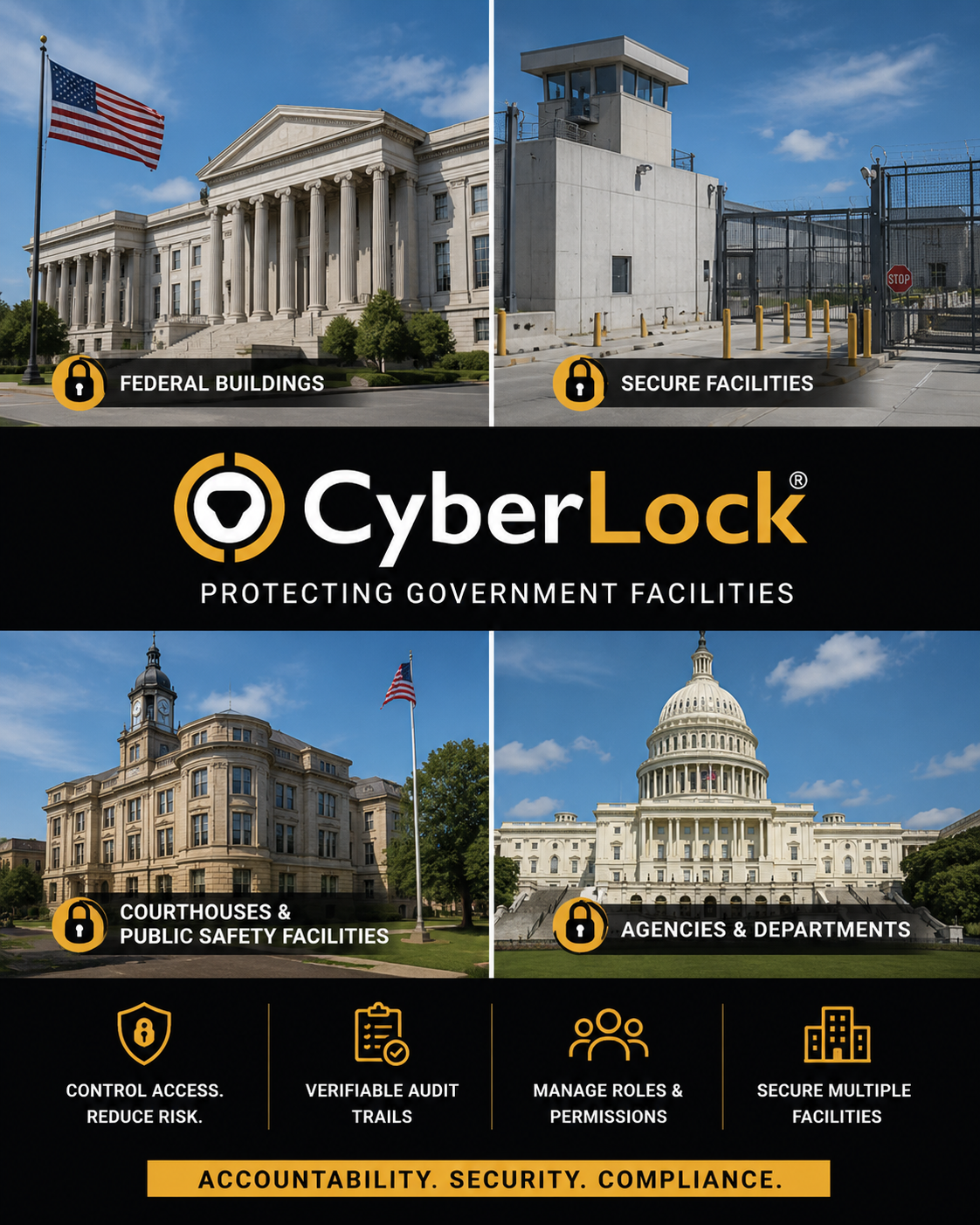
Where Government Access Control Systems Break Down
- Keys are shared between departments, eliminating accountability
- There is no verifiable record of who accessed a facility
- Access permissions are not updated when staff roles change
- Contractors retain access beyond their authorized timeframe
- Access control policies are inconsistent across buildings
- There is no centralized visibility into access activity
These breakdowns are not isolated—they are indicators of a system that lacks accountability at a foundational level. In government environments, these gaps can directly impact audit readiness, compliance efforts, and public trust.
Government and Municipal Access Control Requirements
To maintain accountability and support audit requirements, modern government access control systems must provide:
- Role-based access control across departments and facilities
- Verifiable audit trails to track who accessed each building and when
- Time-based permissions for contractors and temporary users
- Centralized control across multiple facilities
- Real-time permission updates to reflect staffing changes
- Scalability across departments and municipal infrastructure
Without these capabilities, organizations are left reacting to access issues instead of maintaining proactive accountability and control.
How Peifer Solves Government and Municipal Access Control Challenges
Effective access control in government and municipal environments is not achieved by adding more locks—it is achieved by establishing verifiable accountability for every access point across every facility.
Peifer Security Solutions approaches government access control as a system designed to support audit readiness, accountability, and operational consistency across departments and buildings. With experience supporting organizations responsible for public facilities, the focus is on identifying where control breaks down—whether through shared keys, inconsistent permissions, or the inability to verify access.
The process begins with a structured evaluation of how access is currently managed across facilities, departments, and user groups. This includes assessing who has access to each building, how permissions are assigned to employees and contractors, and where gaps in visibility, auditability, and control exist. In many cases, these gaps develop over time as organizations grow, staffing changes occur, and access requirements evolve.
From there, a system is designed to introduce control without disrupting daily operations. For many government and municipal organizations, this includes implementing electronic key systems such as CyberLock electronic access control system. These systems enhance existing infrastructure by combining traditional lock hardware with advanced access management capabilities—allowing organizations to improve accountability without the need for extensive wiring or costly upgrades.
Access is assigned based on roles, departments, and schedules, ensuring that employees, administrators, and contractors can only access the facilities required for their responsibilities. When roles change or access is no longer needed, permissions can be updated or revoked immediately—without rekeying locks.
Every access event is recorded, creating a detailed, verifiable audit trail that provides full visibility into who accessed each facility and when. This level of accountability is essential for supporting audits, meeting compliance requirements, and maintaining operational transparency.
These systems are designed to scale across multiple facilities and departments. Whether managing a single building or a network of municipal locations, Peifer ensures that access control remains consistent, trackable, and aligned with organizational requirements.
Ongoing support ensures that access control continues to evolve with the organization. As facilities expand, departments change, and operational demands grow, Peifer works as a long-term partner to maintain accountability, refine permissions, and ensure continued visibility across all access points.
Government & Municipal Access Control Use Cases
Access control in government and municipal environments must align with how facilities are actually used—across departments, public spaces, staff, and contractors. The following use cases highlight where access control is most critical and how modern systems provide the visibility and accountability required to manage it effectively.
Government Building Access Control
Key Challenges
Government offices and administrative buildings require controlled access across departments and staff roles. Traditional key systems make it difficult to verify who has access to specific buildings or offices, particularly as staffing changes occur.
How Modern Access Control Improves Accountability
Electronic key systems such as CyberLock electronic access control system allow organizations to assign access based on roles and departments while recording every access event. This ensures that access is controlled, traceable, and aligned with organizational policies.
Public Facility Access Control
Key Challenges
Public facilities such as libraries, community centers, and municipal buildings must remain accessible while still maintaining control over restricted areas. Traditional systems often lack the ability to track access within these environments.
How Modern Access Control Improves Accountability
Modern access control systems allow organizations to define access permissions for different areas within public facilities. With solutions like CyberLock electronic access control system, access can be monitored and controlled without limiting public usability.
Department & Staff Access Management
Key Challenges
Government employees often require access to multiple buildings or areas based on their roles. Without clearly defined permissions, access may extend beyond what is necessary, reducing accountability.
How Modern Access Control Improves Accountability
Electronic key systems allow access to be assigned based on roles, departments, and schedules. Permissions can be updated as roles change, ensuring that access remains aligned with responsibilities and policies.
Contractor & Vendor Access Control
Key Challenges
Contractors and vendors require temporary access to government facilities for maintenance, inspections, or services. Without time-based controls, access may remain active longer than necessary.
How Modern Access Control Improves Accountability
Electronic key systems allow organizations to assign time-based permissions, ensuring that contractors can only access facilities during approved windows. Permissions can be revoked immediately once work is completed.
Multi-Facility Municipal Access Control
Key Challenges
Municipal organizations often manage multiple buildings and facilities across departments. Maintaining consistent access control policies across these locations can be difficult with traditional systems.
How Modern Access Control Improves Accountability
Electronic key systems provide centralized management of access permissions across facilities, allowing organizations to maintain consistent policies, track access activity, and ensure accountability across all locations.
Maintaining accountability across facilities requires more than basic security—it requires verifiable control.
Talk with Peifer Security Solutions to design a government access control system that improves auditability, accountability, and control across your facilities.
Why Electronic Key Systems Work in Government and Municipal Environments
Government and municipal organizations require access control systems that support accountability across facilities, departments, and user groups. The challenge is not simply controlling access—it is ensuring that every access event is verifiable, auditable, and defensible.
Electronic key systems such as CyberLock electronic access control system are particularly effective in government environments because they provide the control and auditability required to maintain accountability while supporting day-to-day operations.
One of the most important advantages is the ability to create verifiable audit trails. Every interaction with a lock is recorded, allowing organizations to confirm who accessed a facility, when access occurred, and whether that access aligned with policy. This level of visibility is essential for audit readiness and compliance.
Control over access permissions is another critical factor. Access can be assigned based on roles, departments, and schedules, ensuring that employees and contractors can only access the areas required for their responsibilities. When roles change or access is no longer needed, permissions can be updated or revoked immediately—without rekeying locks.
Consistency across facilities is essential in municipal environments. Organizations often manage multiple buildings with different access requirements. Electronic key systems allow for centralized management of permissions, ensuring that access control policies remain consistent across locations.
Eliminating reliance on traditional key systems also improves accountability. Physical keys can be shared, copied, or lost without detection. Electronic key systems remove this uncertainty by tying access directly to individual users and recording every access event.
Deployment flexibility is another advantage. Many government buildings, particularly older facilities, may not support extensive wired infrastructure. Electronic key systems can be implemented without major modifications, allowing organizations to improve access control without costly upgrades.
Ease of use is important for adoption across departments. Staff and administrators require systems that are straightforward and reliable. Electronic key systems maintain the familiarity of traditional keys while introducing controlled permissions and tracking.
Scalability ensures that the system can grow with the organization. Whether managing a single facility or a network of municipal buildings, electronic key systems can expand without requiring a complete system replacement.
Electronic Key Systems vs Traditional and Wired Access Control in Government
| Capability |
Traditional Keys |
Wired Systems |
Electronic Key Systems |
| Provides audit trail |
No |
Yes |
Yes |
| Tracks access activity |
No |
Yes |
Yes |
| Allows immediate permission updates |
No |
Yes |
Yes |
| Scales across multiple facilities |
No |
Limited |
Yes |
| Requires extensive infrastructure |
No |
Yes |
No |
| Ensures verifiable accountability |
No |
Yes |
Yes |
Electronic key systems provide a practical balance—delivering the auditability, accountability, and flexibility government organizations require without the limitations of traditional systems or the complexity of fully wired solutions.
How to Choose the Right Government and Municipal Access Control System
Selecting the right access control system for government and municipal environments is not about choosing the most advanced technology—it is about choosing a system that delivers verifiable accountability, supports audit requirements, and maintains consistent control across facilities.
In these environments, the inability to verify who accessed a facility, when that access occurred, or whether that access was authorized creates a critical gap in accountability. Access control decisions must be driven by auditability, transparency, and operational reliability—not just system features.
If you cannot verify who accessed a government facility, you cannot demonstrate accountability.
One of the first considerations is the number and type of facilities being managed. Government organizations often oversee multiple buildings with varying access requirements. A system must be able to maintain consistent access control policies while supporting different levels of access across departments and locations.
Departmental access requirements are another key factor. Employees, administrators, and staff may require access to multiple facilities based on their roles. Access control systems must allow permissions to be assigned and updated based on roles and responsibilities to ensure that access remains appropriate and controlled.
Contractor and vendor access must also be carefully managed. Service providers require temporary access to facilities, making it essential to implement time-based controls that limit access to approved timeframes and prevent ongoing exposure.
Visibility into access activity is essential for audit readiness. Government organizations must be able to verify who accessed each facility and when that access occurred, particularly when responding to audits, investigations, or compliance requirements.
Long-term management should not be overlooked. As facilities expand and organizational structures evolve, access control systems must adapt without requiring large-scale rekeying or infrastructure changes. A system that allows centralized control and immediate permission updates provides a more sustainable approach.
Scalability must be built into the system from the beginning. Whether managing a single building or a network of municipal facilities, the system must be able to expand while maintaining consistent accountability and control.
Peifer Security Solutions works with government and municipal organizations to evaluate these factors and design systems that align with both current operations and long-term requirements. The goal is not simply to install a system, but to establish a framework that improves accountability, supports compliance, and ensures consistent control across facilities.
If your current system lacks verifiable audit trails, cannot confirm access activity, or makes it difficult to manage permissions across facilities, it may already be limiting your ability to demonstrate accountability.
Request a government access control assessment to identify audit gaps, improve accountability, and implement a system designed for verifiable control across your facilities.
Frequently Asked Questions About Government Access Control Systems
What is the best access control system for government buildings?
The best access control system for government buildings is one that provides role-based access, verifiable audit trails, and centralized control across facilities. Systems such as CyberLock electronic access control system are often used to support accountability and audit requirements.
Why is access control important for municipalities?
Access control is important for municipalities because it helps manage access across multiple facilities and departments while supporting accountability, security, and operational control.
Can access control systems track who enters a facility?
Yes. Modern access control systems can record access activity, allowing organizations to verify who entered a facility and when access occurred.
How do government organizations manage access for contractors?
Government organizations can assign temporary access to contractors based on their role and the duration of their work. Access can be limited to specific locations and timeframes.
What happens when an employee leaves a government organization?
Access control systems allow permissions to be updated or removed when an employee leaves, helping prevent continued access to facilities.
Can access control systems be used across multiple buildings?
Yes. Many access control systems are designed to manage access across multiple facilities and locations.
Design a Government Access Control System That Supports Accountability and Audit Readiness
In government and municipal environments, access control must deliver more than security—it must provide verifiable accountability across facilities, departments, and personnel.
Managing access across public infrastructure is complex. Without systems that provide visibility and control, organizations may struggle to verify access activity, support audits, or demonstrate compliance with internal policies and external requirements.
Peifer Security Solutions works with government and municipal organizations to evaluate their current access control approach, identify where visibility and accountability are lacking, and design systems that align with operational needs. Through solutions such as CyberLock electronic access control system and other integrated technologies, organizations can establish a structured approach to managing access across facilities.
If your current system lacks audit trails, relies on shared or untracked keys, or makes it difficult to verify who has accessed your facilities, it may already be limiting your ability to maintain accountability.
Related CyberLock Industry Solutions