

Menu

Call Now (901) 363-6396 Service Request

CyberLock for Logistics and Warehousing Facilities

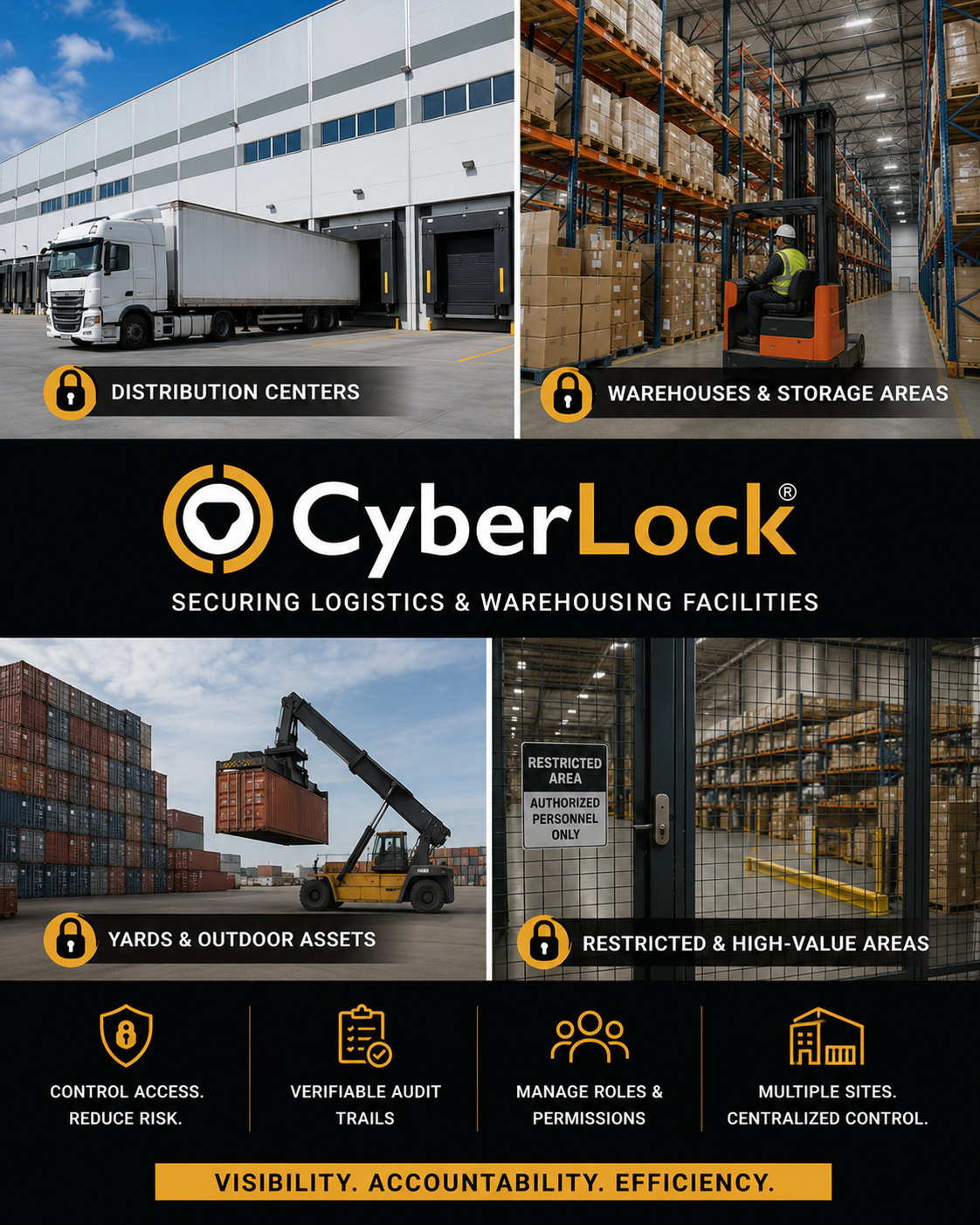
CyberLock Access Control for Logistics and Warehousing Facilities

CyberLock Access Control for Logistics and Warehousing Facilities

In logistics and warehousing environments, access control is not just about security—it is about protecting inventory, maintaining chain of custody, and ensuring that only authorized personnel can access critical areas across the facility.

Warehouses and distribution centers operate in high-volume environments where inventory is constantly moving. Storage areas, inventory zones, and shipping and receiving locations must be carefully controlled. Without defined access, unauthorized entry can lead to inventory shrinkage, misplacement, and uncontrolled movement of goods.

This creates a significant challenge. Employees, supervisors, contractors, and vendors often require access to different parts of a facility based on their roles. Many operations also run across multiple shifts, increasing the number of individuals who may access inventory areas throughout the day.

Without a system to control and verify access, it becomes difficult to ensure that only authorized personnel are handling inventory. In these situations, accountability is limited, and movement of goods is not fully controlled.

Traditional key systems are a common source of this problem. Keys may be shared across employees, copied without oversight, or not returned. There is often no clear record of who has access to inventory areas or when those areas are accessed.

This lack of control introduces real financial risk. Unrestricted access to inventory zones can increase the likelihood of shrinkage, loss, and unauthorized movement of goods. Without visibility, it becomes difficult to identify where breakdowns are occurring.

Managing access for contractors and vendors adds another layer of complexity. External personnel may require temporary access to specific areas, but without time-based controls, access may remain active longer than necessary.

Large facilities and multiple locations can further complicate access control. Without centralized visibility, it can be difficult to maintain consistent policies across warehouses or distribution centers.

Fully wired access control systems can provide centralized management, but they may introduce complexity and higher costs—particularly across large or distributed operations.

Modern warehouse access control systems must go beyond basic security. They must provide the ability to restrict access to inventory areas, assign permissions based on roles and schedules, and track access activity across the facility.

Solutions such as CyberLock electronic access control system allow organizations to implement controlled, trackable access while improving operational efficiency.

If you cannot control access to inventory, you cannot control loss.

With experience supporting logistics and warehousing operations where inventory protection and controlled access are critical, Peifer Security Solutions focuses on aligning access control systems with how facilities actually operate—helping organizations reduce risk, improve accountability, and maintain control across their operations.

Read More

What Is the Best Access Control System for Warehouses and Logistics Facilities?

The best access control system for logistics and warehousing environments is one that allows organizations to control and verify access to inventory areas while maintaining visibility across facility operations.

Warehouses and distribution centers include multiple zones such as storage areas, picking locations, and shipping and receiving zones. Employees, supervisors, contractors, and vendors often require access to different parts of the facility, and many operations run across multiple shifts. Without structured access control, it becomes difficult to ensure that only authorized personnel are handling inventory.

Traditional key systems create limitations. Keys may be shared or duplicated, and there is often no reliable way to track who has access or when inventory areas are accessed. This lack of visibility can lead to shrinkage, misplacement, and unauthorized movement of goods.

Modern access control systems allow organizations to assign permissions based on roles, schedules, and responsibilities while recording access activity. This provides greater visibility into who is entering inventory zones and when access occurs.

Electronic key systems such as CyberLock electronic access control system provide a practical solution by enabling controlled access without requiring extensive infrastructure changes.

By improving control over inventory areas and providing visibility into access activity, these systems help logistics organizations reduce loss, strengthen accountability, and maintain more consistent operations.

Common Logistics and Warehousing Access Control Challenges

Access control in logistics and warehousing environments rarely fails because security measures are missing—it fails because organizations lack the ability to control, verify, and track access to inventory across facilities.

Warehouses and distribution centers manage large volumes of inventory that move through multiple zones, including storage areas, picking locations, and shipping and receiving areas. Without structured access control, it becomes difficult to ensure that only authorized personnel are handling inventory.

One of the most significant challenges is the lack of visibility into who has access to inventory areas. Traditional key systems provide no reliable way to confirm who holds keys, whether copies have been made, or when access occurs. Keys are often shared across employees and shifts, reducing accountability.

This lack of visibility can create financial risk. Uncontrolled access to inventory zones can increase the likelihood of shrinkage, misplacement, and unauthorized movement of goods. Without a clear record of access, it becomes difficult to identify where loss or breakdowns are occurring.

Shift-based operations add another layer of complexity. Facilities operating across multiple shifts often have different groups of employees requiring access at different times. Without time-based controls, access may not align with work schedules, increasing exposure to inventory.

Contractors and vendors present additional challenges. External personnel may require temporary access to support logistics operations, but without clear limits, access may remain active longer than needed—creating unnecessary risk.

Large facilities and multiple locations can make access control more difficult to manage. Without centralized visibility, policies may vary across warehouses or distribution centers, leading to inconsistencies and gaps in control.

Another common issue is the lack of access tracking. Without an audit trail, organizations may not be able to verify who entered inventory areas or when access occurred. This limits the ability to maintain chain of custody and respond to issues.

Where Warehouse Access Control Systems Break Down

  • Keys are shared between employees across shifts
  • There is no record of who accessed inventory areas
  • Access is not aligned with job roles
  • Contractors retain access beyond their required timeframe
  • Inventory zones are not consistently restricted
  • There is no centralized visibility into access activity

These breakdowns are not isolated—they are indicators of a system that lacks control over inventory access. In logistics environments, these gaps can directly impact loss prevention, operational efficiency, and accountability.

Logistics Access Control Requirements for Warehousing Facilities

To maintain inventory protection and operational control, modern logistics access control systems must provide:

  • Role-based access control for employees and contractors
  • Restricted access to inventory zones
  • Time-based permissions for shift operations
  • Access tracking and audit capabilities
  • Centralized control across facilities
  • Scalability for multi-location operations

Without these capabilities, organizations are left reacting to inventory issues instead of maintaining proactive control over access and movement.

How Peifer Solves Logistics and Warehousing Access Control Challenges

Effective access control in logistics and warehousing environments is not achieved by adding more locks—it is achieved by establishing controlled, verifiable access to inventory across facilities.

Peifer Security Solutions approaches warehouse access control as a system designed to support inventory protection, chain of custody, and operational consistency across storage zones, shifts, and locations. With experience supporting logistics operations, the focus is on identifying where control breaks down—whether through shared keys, inconsistent permissions, or lack of visibility into inventory access.

The process begins with a structured evaluation of how access is currently managed across the facility. This includes identifying which areas require restricted access, who currently has access to inventory zones, and where gaps in control or visibility exist. In many cases, these gaps develop over time as operations scale, staffing changes occur, and shift-based workflows increase complexity.

From there, a system is designed to introduce control without disrupting daily operations. For many logistics and warehousing environments, this includes implementing electronic key systems such as CyberLock electronic access control system. These systems enhance existing infrastructure by combining traditional lock hardware with controlled access capabilities—allowing organizations to improve accountability without extensive upgrades.

Access is assigned based on roles, areas, and schedules, ensuring that employees, supervisors, and contractors can only access the parts of the facility required for their responsibilities. This is particularly important in environments with multiple shifts, where access must align with operational workflows.

Every access event can be recorded, providing visibility into who is entering inventory zones and when access occurs. This supports better accountability, helps maintain chain of custody, and makes it easier to identify where issues may arise.

These systems can be applied across large facilities or multiple locations, helping organizations maintain consistent access control practices as operations expand.

Ongoing support ensures that access control continues to align with operational needs. As facilities grow, roles change, and new personnel are introduced, Peifer works with organizations to maintain consistent control across all inventory areas.

Request a Warehouse Access Control Assessment

If your operation involves high-value inventory, multiple shifts, or limited visibility into who has access to inventory areas, it may be time to evaluate your current approach.

Request a Warehouse Access Control Assessment

Logistics & Warehousing Access Control Use Cases

Access control in logistics and warehousing environments must align with how inventory moves through a facility—across storage zones, shipping areas, shifts, and personnel. The following use cases highlight where access control is most critical and how modern systems help maintain control over inventory and operations.

Inventory Area Access Control

Key Challenges

Warehouses often store high-value inventory that must be protected from unauthorized access. Without controlled entry to storage areas, it can be difficult to manage who is handling inventory.

How Modern Access Control Improves Inventory Protection

Electronic key systems such as CyberLock electronic access control system allow organizations to restrict access to inventory zones based on roles and responsibilities. This helps ensure that only authorized personnel can access specific storage areas.

Shipping and Receiving Access

Key Challenges

Shipping and receiving areas involve frequent movement of goods and personnel. Without controlled access, it may be difficult to monitor who is entering these areas or handling inventory during transfers.

How Modern Access Control Improves Accountability

Access can be assigned to specific roles, helping organizations control who can enter shipping and receiving zones and maintain better oversight of inventory movement.

Shift-Based Workforce Access

Key Challenges

Many logistics facilities operate across multiple shifts, with different employees requiring access at different times. Without structured controls, access may not align with work schedules.

How Modern Access Control Improves Operations

Access can be assigned based on schedules, allowing employees to enter inventory areas only during their designated shifts. This helps maintain control and reduce unnecessary exposure.

Contractor and Vendor Access

Key Challenges

Contractors and vendors may require temporary access to support logistics operations. Without limits, access may continue beyond the required timeframe, increasing risk.

How Modern Access Control Improves Control

Electronic key systems allow organizations to assign time-based permissions, ensuring that contractors can only access specific areas during approved timeframes. Permissions can be adjusted or revoked when work is completed.

Multi-Facility Logistics Operations

Key Challenges

Organizations with multiple warehouses or distribution centers may find it difficult to maintain consistent access control across locations. Policies may vary, and visibility may be limited.

How Modern Access Control Improves Consistency

Electronic key systems can be used to manage access across facilities, helping organizations apply consistent policies, maintain visibility, and support accountability across locations.

Maintaining control over inventory and facility access requires more than basic security—it requires structured, trackable access.

Talk with Peifer Security Solutions to design an access control system that improves inventory protection and operational control across your logistics operations.

Why Electronic Key Systems Work in Logistics and Warehousing Environments

Logistics and warehousing facilities require access control systems that support daily operations while maintaining consistent control over inventory areas and facility access points. The goal is not only to manage access, but to ensure that access is aligned with inventory protection and operational workflows.

Electronic key systems such as CyberLock electronic access control system are well-suited for logistics environments because they provide a structured approach to managing access without requiring extensive infrastructure changes.

One of the primary advantages is the ability to control access to inventory zones. Permissions can be assigned based on roles, ensuring that only authorized personnel can enter storage areas, picking zones, and shipping or receiving locations.

These systems also support shift-based operations. Access can be assigned based on schedules, allowing employees to enter specific areas only during their designated shifts. This helps align access with operational needs and reduces unnecessary exposure to inventory.

Another benefit is improved visibility into access activity. By recording when access occurs, organizations can gain insight into who is entering inventory areas and when goods are being handled.

Electronic key systems also reduce reliance on traditional keys, which may be shared or difficult to track. By introducing a more controlled approach, organizations can improve accountability and reduce the risk of unauthorized access.

These systems can be applied across large facilities or multiple locations, helping organizations maintain consistent access control practices as operations expand.

Electronic Key Systems vs Traditional and Wired Access Control in Warehousing

Capability Traditional Keys Wired Systems Electronic Key Systems
Track access activity No Yes Yes
Control inventory zones Limited Yes Yes
Supports shift-based access No Yes Yes
Requires infrastructure installation No Yes No
Scales across facilities No Limited Yes


How to Choose the Right Warehouse and Logistics Access Control System

Selecting the right access control system for a warehouse or logistics operation is not just about choosing a technology—it is about choosing a system that can maintain control over inventory while supporting daily operations.

In logistics environments, access directly impacts inventory protection and accountability. If access to inventory areas is not properly controlled, unauthorized handling of goods can lead to shrinkage, misplacement, and loss.

If you cannot control access to inventory, you cannot control loss.

One of the first considerations is the layout and size of the facility. Warehouses often include multiple zones such as storage areas, picking locations, and shipping or receiving zones. A system must be able to support different levels of access across these areas.

Another key factor is how access is assigned and managed. Employees, supervisors, contractors, and vendors may all require access at different times and to different locations. A system that allows permissions to be assigned based on roles and updated as responsibilities change helps maintain control.

Shift-based operations are also important to consider. Facilities that operate across multiple shifts require access control that aligns with work schedules. Time-based permissions help ensure that individuals can access only the areas they need during their designated shifts.

Contractor and vendor access must also be managed carefully. External personnel often require temporary access to support operations, and a system should allow permissions to be limited by both location and timeframe.

Visibility into access activity is another important consideration. Being able to track who is entering inventory zones and when access occurs helps organizations maintain accountability and respond to potential issues.

Scalability is important for operations that may expand or operate across multiple locations. A system should be able to grow with the organization while maintaining consistent control across facilities.

Peifer Security Solutions works with logistics and warehousing organizations to evaluate these factors and identify systems that align with both current operations and long-term needs.

If your operation relies on shared keys, lacks visibility into inventory access, or cannot control access across shifts and facilities, it may already be increasing your risk of loss.

Request a warehouse access control assessment to identify inventory risks and implement a system designed for controlled access across your operations.

Frequently Asked Questions About Logistics and Warehousing Access Control Systems

What is the best access control system for warehouses?

The best access control system for warehouses is one that restricts access to inventory areas, supports shift-based permissions, and tracks access activity. Systems such as CyberLock electronic access control system are commonly used to help improve inventory control and reduce loss.

Why is access control important in logistics operations?

Access control is important in logistics operations because it helps limit entry to inventory zones, reduce the risk of shrinkage, and maintain better control over the movement of goods.

Can access control systems restrict access to inventory areas?

Yes. Access control systems can be used to limit entry to specific zones, such as storage areas or picking locations, based on roles and permissions.

How do warehouses manage access across shifts?

Warehouses can assign access based on schedules, allowing employees to access specific areas during their designated shifts.

How is contractor access managed in logistics facilities?

Contractors can be given temporary access to specific areas for defined periods, helping ensure that access is limited to the duration of their work.

Can access control systems be used across multiple warehouses?

Yes. Many access control systems can be used to manage access across multiple facilities or distribution centers.

Design a Warehouse Access Control System That Protects Inventory and Improves Operational Control

In logistics and warehousing environments, access control must deliver more than security—it must provide consistent control over inventory and movement across facilities.

Managing access across storage areas, personnel, and operations is complex. Without systems that provide visibility and control, organizations may experience inventory loss, misplacement, and gaps in accountability.

Peifer Security Solutions works with logistics and warehousing organizations to evaluate their current access control approach, identify where visibility and control are limited, and design systems that align with operational needs. Through solutions such as CyberLock electronic access control system and other integrated technologies, organizations can establish a structured approach to managing access across facilities.

If your current system relies on shared keys, lacks visibility into inventory access, or makes it difficult to control access across shifts and locations, it may already be increasing your risk of loss.

Schedule a warehouse access control consultation with Peifer Security Solutions to assess your facilities, identify inventory risks, and implement a system designed for improved control, reduced loss, and long-term operational efficiency.

Read More

Schedule a warehouse access control consultation with Peifer Security

If your current system relies on shared keys, lacks visibility into inventory access, or makes it difficult to control access across shifts and locations, it may already be increasing your risk of loss.

Schedule a warehouse access control consultation .